

Stop Collecting Moves, Start Mastering Them.
A better way to practice cardistry

Recently, we asked two questions on Instagram:
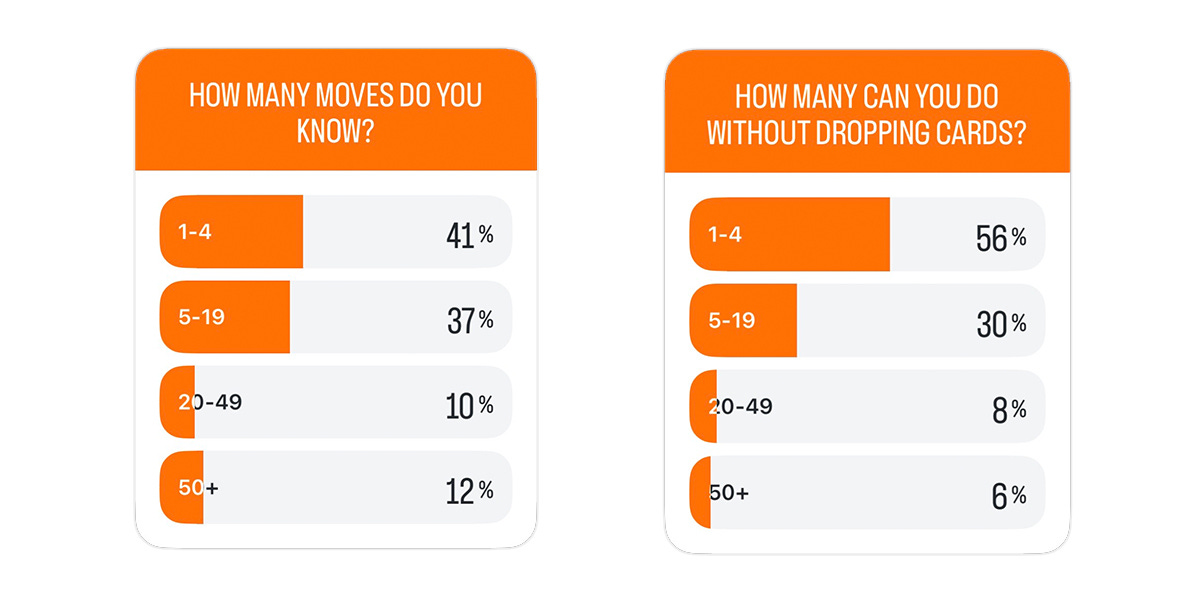
Over 600 of you responded to each question, and the results told a very clear story.
While the number of people that know either 1-4 moves or 5-19 moves were similar, there’s a substantial difference between how many people can cleanly perform 1-4 moves vs 5-19 moves.
In other words, there’s a lot of cardists out there who know 5-19 moves, but can only perform 1-4 of them cleanly.
That gap between knowing and doing reveals one of the biggest misunderstandings in cardistry: learning and mastering are not the same thing.
Learning a Move vs. Mastering a Move
Every cardistry move has two very distinct phases:
Learning the mechanics – understanding where your fingers go and how the packets move
Mastering the move – being able to do it confidently, smoothly, and without dropping cards
The first phase is exciting. Learning a new move feels like instant progress. You watch a tutorial, struggle for a bit, and suddenly you can do something new. That rush is part of what makes cardistry so addicting.
The second phase is where things slow down.
Mastering a move takes time. Sometimes a lot of time, especially once you start pushing into higher difficulty territory (think Level 6+ moves). Those moves can feel learnable pretty quickly, but turning them into something you can perform consistently is a completely different challenge.
And this is where a lot of cardists, understandably, get stuck.
Why We Keep Chasing New Moves
Cardistry is endless.
There’s always another move, another style, another idea to explore. For beginners especially, it feels like progress comes from learning more.
That’s where context on the difficulty of a move really matters.
Without some sense of where you are skill-wise, it’s easy to fall into a loop: learn a move that’s just a bit too hard → struggle to perform it consistently → move on to another move that’s also too hard → repeat.
Your “progress” feels good, but the confidence never quite shows up.
Practicing is simple, but it isn’t easy.
A good way to think about it is the difference between scrolling short-form content and sitting down to watch a full-length YouTube video.
Scrolling reels is easy. It’s instantly rewarding and requires very little commitment.
Watching a longer video takes more effort, but the ideas tend to stick. You walk away with something more concrete, a deeper connection to what you just experienced, and something that often changes how you think.
Learning new moves often feels like the reels. Practicing them deeply feels like the long-form video. One is exciting in the moment. The other embeds itself into your hands and stays with you.
Practice With Intention
Here’s something I wish I understood much earlier in my own journey:
Repeating a move isn’t the same as practicing it.
For years, I would run moves on loop without much intention. If it worked, great. If it didn’t, I’d just try again without really paying attention to why. That approach works eventually, but it’s inefficient and it slows your overall progress.
Intentional practice means noticing the small things:
where tension builds up
when packets get messy
which finger placement slows you down
why a move fails instead of just restarting it
That awareness is what helps you actually improve from repetition, and it’s what allows you to progress within your current level instead of constantly jumping ahead.
Focused Practice vs. Passive Practice
Not all practice needs full concentration.
There’s real value in doing moves while watching TV, listening to music, or even talking with friends. In those moments, your hands are forced to do the work without your brain micromanaging every motion. That’s how muscle memory really starts to lock in.
The sweet spot is ebb and flow:
focused sessions where you analyze and make adjustments
relaxed sessions where repetition reinforces what you’ve already learned
Over time, moves stop feeling forced. They start to feel natural.
Depth Beats Breadth
One of the hidden gems of cardistry is realizing that one move practiced deeply is more rewarding than five learned at the surface level.
Take someone like Daren Yeow.
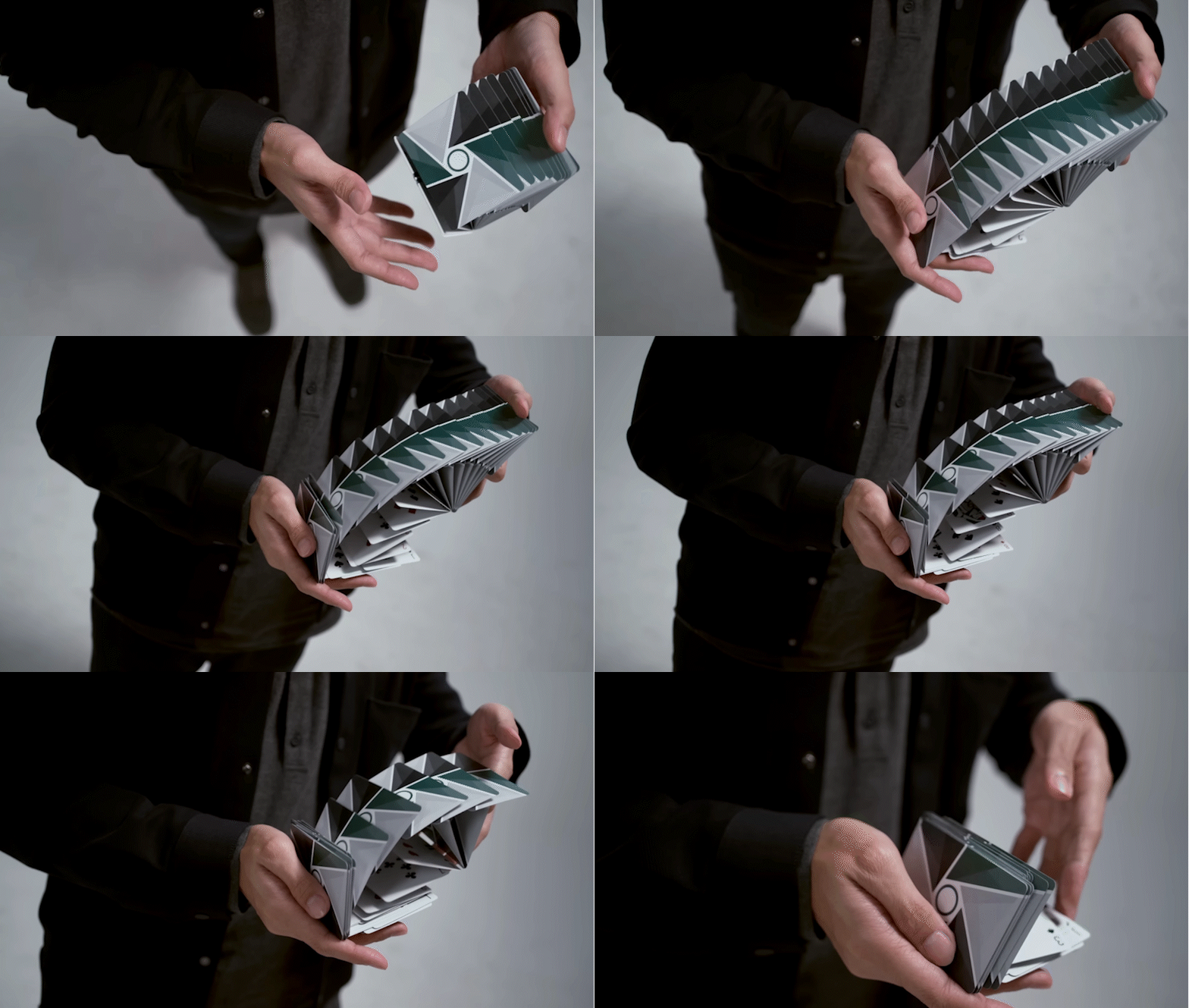
His repertoire is relatively small, but the control is unreal. He can perform some of the most difficult moves cold, with no warm-up, even with decks that would normally spill everywhere. As a spectator, it’s mesmerizing. But as a performer, it’s even better.
There’s a word Sam Pratt once used that captures this perfectly:
sprezzatura – making something difficult look effortless.
That quality doesn’t come from learning more moves, it comes from spending more time with the ones you already know.
A Question Worth Asking Yourself
So here’s something to reflect on:
How many moves do I know that I can actually perform with confidence?
Obviously, you can’t perform more moves than you actually know, but if there is a substantial gap between what you know and what you can perform cleanly, perhaps it’s time to revisit some of them.
Would your cardistry improve more by learning something new, or by mastering what you already know?
There’s no single “right” path. Some cardists want mastery. Others want exploration.
But it can be difficult to find your own path without a sense of direction.
We’ve been quietly building something around that idea, and we’ll be sharing more about it very soon. If you’re excited about improving with more intention and being part of a cardistry community that values curiosity, growth, and conversation, keep an eye out over the next couple of weeks.
Quick question before you go: what’s one move you’re trying to master right now?
Let us know in the comments below.
Happy practicing,
Dom

1. Double Barrel by Daniel
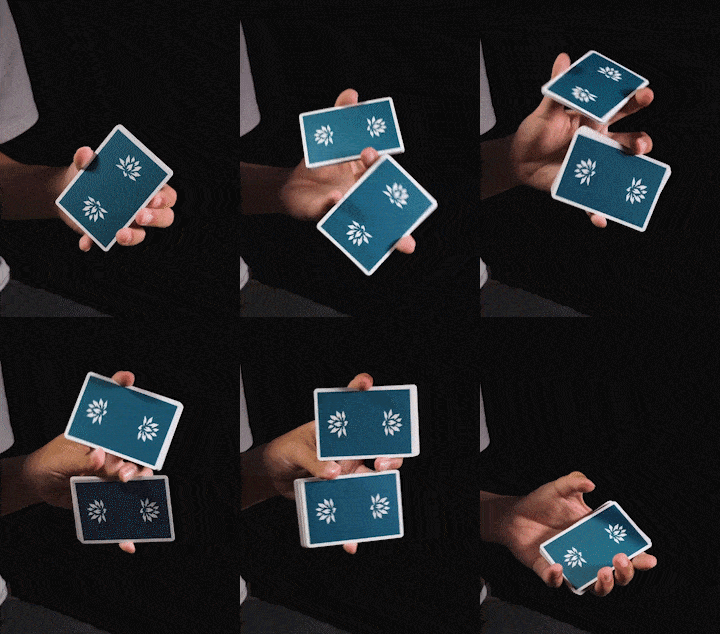
Every once in a while, a move comes along that expands what cardistry can be.
Daniel’s discovery is one of those moments. Not because it’s complex, but because it introduces an entirely new idea using just two packets. That alone is almost unheard of. Most two-packet territory has been mapped out for years, which makes finding something this fresh feel borderline impossible.
The concept is shockingly simple: offset rotations with a slight delay. Yet no one had thought to look for it this way. Once you see it, it feels obvious.
Under the surface, the execution tells a different story. Subtle regrips and constant finger adjustments power the motion, giving the move depth far beyond its minimal structure.
This isn’t just a great move. It’s a reminder that even in the most explored spaces, there are still new ideas waiting to be uncovered.
2. Bloom 2+2 by Luke

The funny thing about this feature is that it’s completely outside of what you’d expect from Luke on a typical day — and if you follow him, you know that “typical” already means something pretty wild.
Luke has more than earned his reputation as the aerial king. His recent debut video CARDS IN THE WIND is a perfect snapshot of that style.
And then he dropped this.
Bloom 2+2 takes an already difficult concept and pushes it into new territory by creating two blooms that interlock and expand upward together, forming a tall, layered structure of cards.
It’s a great reminder of Luke’s range. Even when he steps away from aerial-heavy territory, he’s still finding new ways to challenge what feels possible with a deck.
3. Off The Wall by Hans
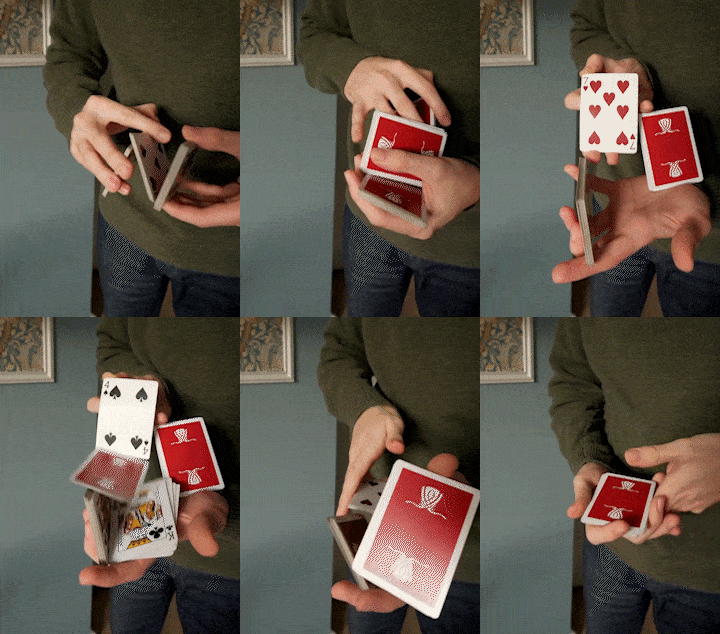
This move by Hans stands out for introducing a mechanic we almost never see used this deliberately.
The defining moment is a dribble that sends single cards off the edge of a sideways packet, hitting it consistently one after the other and tumbling into the palm. Each card follows the same path, recreating a packet he uses to continue the cut.
What makes it work is the control. Instead of ending abruptly, the move closes neatly, sealing the packet cut in a way that feels intentional.
It’s rare to see a move that builds an entire packet cut around a single, well-executed moment.
Honorable Mentions
January was stacked with other talented cardists who dropped new moves:
Quick Bites
Cardistry, Every Week: We’re committing to something you don’t see much anymore: consistent cardistry on YouTube. New videos every week — tutorials, theory and discussion videos, Q&As, practice sessions, meetups, and more. We’re just getting started, and we’d love for you to be part of the journey as we help push the cardistry community forward. Catch up on the videos we’ve dropped over the past few weeks.
Legendary Return: After a long silence, Aviv returned with a decade-in-the-making cardistry project and a 52-day learning experiment. He also dropped a deep, 40-minute breakdown of his move Slinky within the project.
The World Stage: Qualifiers completed and Preliminaries are underway for the Cardistry World Cup, as teams of 3 from 19 nations compete for the first ever Cardistry World Trophy. If you’ve been needing some cardistry inspiration, look no further than their Instagram page, as it’s been filled with bangers this month.
Get a Grip: New grips just dropped, courtesy of Sam Pratt. Feel free to give them a shot. We promise they’re totally comfortable and won’t hurt your hands at all…
Cardistry in Copenhagen: Cardistry-Con announced the dates for this year’s event – July 25-26. The biggest cardistry event of the year will take place in Copenhagen, so be sure to grab your tickets when they go on sale February 1st.
Community Highlights
Check out these notable cardistry videos from January:
2025: Year of the Goos
Goos Cards
Humans of Cardistry-Con 2025
Humans of Cardistry
Salvage1 Hong Kong #cardistry OG
YANGANYAUHEI
meow (real)
Carter MacDiarmid
百合
Buseong Na
“Flux Pinning” - Cardistry by terfno
terfno
Did we miss anything from this month? Feel free to leave a comment down below!
Thanks for reading. We’ll see you again soon.
SQUAREUP Team
Conor and Dom
Love the read about intentional and passive practise, and the benefits of each! I like to do 15min sessions of "diagnosing" what is going wrong in a move, so I can pay more attention to those areas.
Thanks for the shoutout on Off The Wall too!
Very interesting, thanks!! I'm a beginner in cardistry, practicing it since one month. Now I'm trying to master sybil cut and the werm...so cool! 😎